



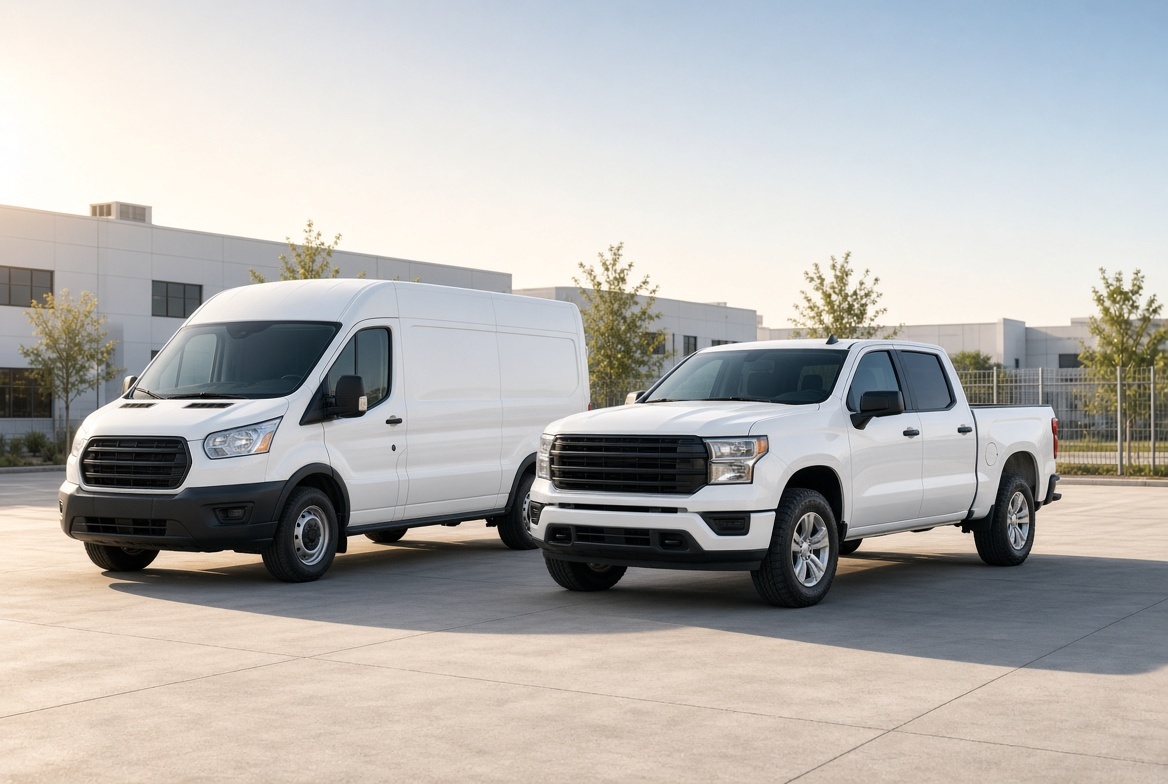
Acquisition costs for work vans and pickups stayed elevated through 2026, driven in part by tariff effects and higher transaction prices. Average van prices climbed roughly 7 percent year over year while full-size pickups rose more modestly. Against that backdrop, several manufacturers increased their national fleet incentive programs for the 2027 model year. For small fleets replacing vehicles in modest volumes, those higher incentives are one of the clearest offsets available.
The practical question is not whether incentives exist. It is whether the higher amounts meaningfully improve the net cost of the specific configurations you need, and whether your order timing captures them.

How 2027 Incentives Compare to 2026 on Core Work Vehicles
Ford’s National Fleet Incentive (56M) program shows the pattern clearly. In 2027, the incentive on a Transit cargo van low roof rises to $2,000 from $1,000 in 2026. Medium- and high-roof Transit vans move from $1,000 to $1,500. Super Duty pickups in regular and SuperCab configurations increase from $1,000 to $2,500. Crew-cab Super Duty pickups rise from $1,000 to $1,500. Chassis-cab versions vary by configuration, with some reaching $3,000.
These figures come from Ford Pro program documents and independent fleet-cost analyses that tracked the changes. Other manufacturers have also published 2027 commercial programs. Hyundai’s commercial incentives, for example, range from $1,000 to $5,500 depending on the model. Exact amounts change during the model year, so the only reliable number is the one attached to the vehicle you are ordering on the day you place the order.
Why the Higher Incentives Matter More This Year
Even with stronger incentives, base pricing on many vans and pickups has not fallen. A 2027 Ford Transit Cargo Van starts in the mid-to-high $40,000s before options and destination, and fully configured units used for local work often land well above that. The 2027 Ram ProMaster City, by contrast, has been positioned with a starting price under $40,000, giving smaller fleets another data point when they compare total acquisition cost.
The net effect is that the incentive increase can narrow the gap created by higher transaction prices, but it rarely eliminates it. Fleets that treat the incentive as a simple cash reduction, without re-running the full cost of the specific unit they need, can still end up paying more than expected. This is especially true when upfit packages, powertrain choices, or higher-roof configurations reduce the incentive amount or add cost elsewhere.
How to Evaluate Whether the Incentive Actually Helps Your Numbers
Start with the exact configuration you need, not the advertised base price. A low-roof Transit that qualifies for the full $2,000 incentive may look different once you add the roof height, engine, and equipment your routes require. Ask for the incentive amount that applies to that specific order, not the highest number listed for the model line.
Next, compare the net price of the 2027 unit against the cost of keeping the current vehicle another year. Rising repair costs on older vans and pickups can quickly offset any savings from delaying a replacement. If the net cost of the new unit, after incentive, is still higher than expected, the incentive has not fully solved the problem; it has only reduced the size of the increase.
Finally, confirm eligibility and stacking rules. Most national fleet incentives require a valid fleet identification number and apply only to commercial sales. They often cannot be combined with certain retail offers. A fleet that hasn't maintained its fleet account or tries to layer incompatible programs can lose the incentive entirely.
Timing Considerations for Small Fleets
Order windows and production schedules for 2027 models are already active on several popular vans and pickups. Incentives can change or expire mid-year, and some programs are tied to specific delivery dates. Small fleets that wait until the last moment to decide sometimes find the incentive lower or the preferred configuration unavailable.
At the same time, there is no requirement to replace every vehicle simply because a higher incentive is available. A better approach is to identify units whose maintenance costs or reliability are already trending the wrong way, then check whether the current 2027 incentive on a suitable replacement improves the overall cost picture enough to justify moving now.
Key Takeaways
- National fleet incentives on several core work vans and pickups are higher for the 2027 model year than they were for 2026.
- Higher incentives help offset, but do not erase, the elevated acquisition prices many fleets saw in 2026.
- Always confirm the incentive amount on the exact configuration you need; base-model numbers can be misleading.
- Compare the net cost of a 2027 unit against the cost of keeping the current vehicle, not against last year’s price alone.
- Eligibility rules and program changes mean the incentive is only real once it is confirmed on your order.

FAQ
Do the higher 2027 incentives apply to both vans and pickups?
Yes. Increases appear on Transit vans as well as Super Duty and other pickup configurations, though the exact amount varies by model, roof height, and cab style.
Can small fleets qualify for these national programs?
Most national fleet incentives require a valid fleet identification number and commercial use. Fleets that already purchase or lease through a fleet program are typically eligible; those that do not may need to set up an account first.
Are the incentives guaranteed for the entire model year?
No. Programs can be revised, and some offers are tied to specific order or delivery windows. The amount that matters is the one confirmed when your order is placed.
Should we replace vehicles just because the incentive is higher?
Only if the net cost, after incentive, improves the total cost of ownership compared with keeping the current unit. Higher incentives help, but rising repair costs and downtime on older vehicles are usually the stronger reasons to replace.
Where can we see the current incentive amounts?
The most accurate source is the manufacturer’s current fleet incentive documentation or a confirmation from the dealer or fleet provider on the specific vehicle you plan to order. Public summaries can lag the official program.
For fleets weighing replacement timing against these 2027 programs, reviewing current fleet leasing options for vans and pickups can clarify how the incentive flows into the monthly cost. Independent analysis of overall fleet cost trends heading into 2027 provides additional context on what the incentives are actually offsetting. Official manufacturer program details remain the final reference for any specific order.